

Smoke-Free Nicotine Myths vs Facts: What the Evidence Actually Says

Few consumer categories are as clouded by misinformation as smoke-free nicotine. Surveys repeatedly find that large shares of the UK public — including many smokers — hold beliefs about vaping, pouches and nicotine that run directly counter to the evidence, and that gap has real consequences: it keeps smokers smoking, muddles sensible regulation, and clutters every conversation a nicotine user has with family and friends. This article works through the most persistent myths across the smoke-free landscape and puts each against what the evidence and UK public health bodies actually say — with the genuine uncertainties stated honestly, because good harm-reduction needs no exaggeration in either direction. It’s not cheerleading and it’s not scaremongering; it’s an attempt to state the record clearly on a topic where the record is unusually distorted. If you’ve ever been unsure what to believe, this is the myth-clearing you’ve been looking for.
Myth 1: ‘Vaping Is as Bad as Smoking’
The most consequential myth, believed by a startling share of the public and contradicted by the central finding of UK tobacco science. The logic is mechanical: smoking’s harm comes overwhelmingly from combustion — burning tobacco produces smoke carrying thousands of chemicals, tar and carbon monoxide — and vaping burns nothing, eliminating that chemistry at source. UK public health bodies, reviewing the evidence repeatedly, have long held that vaping is substantially less harmful than smoking, a position that underpins NHS-aligned advice that smokers who switch completely stand to benefit significantly. ‘Less harmful’ is not ‘harmless’ — this article will say so plainly below — but ‘as bad as smoking’ isn’t caution, it’s misinformation, and its cost is measured in the smokers it discourages from ever switching. The gap between this belief and the evidence is arguably the single most harmful piece of nicotine misinformation in circulation.
Myth 2: ‘Nicotine Causes Cancer’
A conflation so widespread that many smokers believe the addictive substance is the one giving them cancer — with real consequences for how they weigh their options. The evidence position: nicotine is the addictive component of smoking, not the principal carcinogen. The cancers of smoking are driven by the combustion products — the tar and chemicals in smoke — which is exactly why medically licensed nicotine replacement (patches, gum, lozenges) has been used safely for decades. Nicotine isn’t benign: it’s genuinely addictive, affects the cardiovascular system, and has no place in adolescence or pregnancy — those caveats stand firmly. But ‘addictive’ and ‘carcinogenic’ are different properties, and collapsing them keeps smokers frightened of the one ingredient that was never the main assassin while they keep inhaling the ones that are. Understanding this distinction is genuinely liberating for anyone weighing a switch to a smoke-free product.
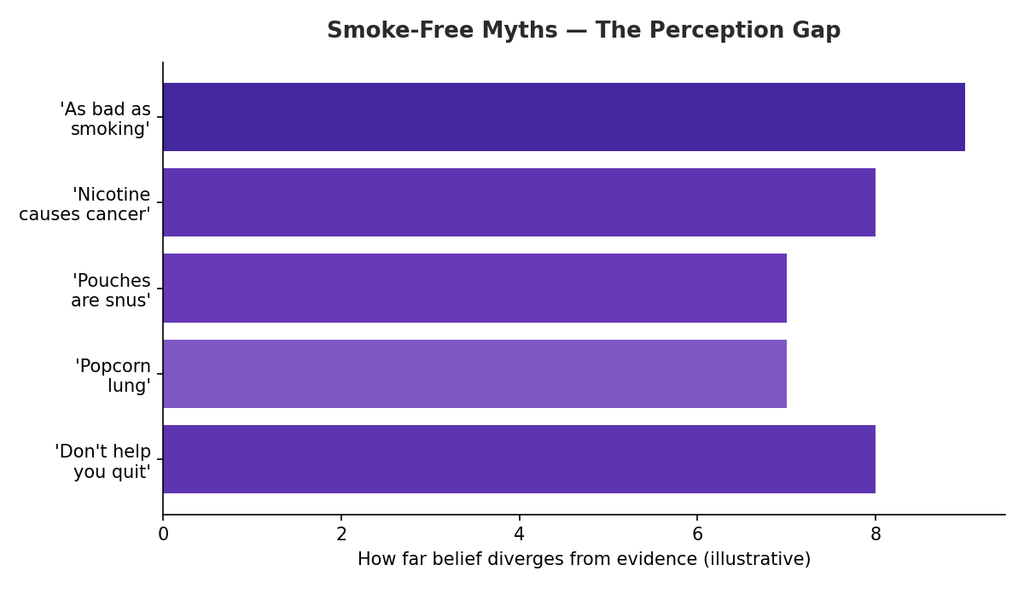
Smoke-free nicotine — where public belief diverges most from the evidence.
Myth 3: ‘Nicotine Pouches Are Just Snus’
This one is less about health than accuracy, but it causes real confusion. People routinely call nicotine pouches ‘snus’, assuming they’re the same banned product — but they’re materially and legally different. Snus is a moist oral tobacco product containing actual tobacco leaf, and it has been banned for sale in the UK since 1992 precisely because it’s a tobacco product. Nicotine pouches are tobacco-free — plant fibre, nicotine and flavourings — which is exactly why they’re legal for adults in the UK where snus is not. The confusion is understandable (both sit under the lip, both deliver nicotine) but the difference matters: one is banned tobacco, one is legal tobacco-free. For anyone genuinely unsure, a clear explainer of what is snus versus the modern pouch settles it — and knowing the distinction matters, because it explains why you can legally buy one and not the other.
Myth 4: ‘Vaping Gives You Popcorn Lung’
The most durable vaping scare, and a case study in how a fact becomes a myth. The fact: diacetyl, a buttery flavouring chemical, caused serious lung disease in factory workers heavily exposed to it. The myth: that vaping delivers the same fate. The record: diacetyl has been banned from UK vape liquids for years under the regulations governing the category, and no confirmed case of ‘popcorn lung’ has been attributed to vaping. The kernel worth keeping is real — flavouring chemistry matters, which is precisely why UK regulation tests and restricts ingredients, and why buying compliant products from established retailers matters. But the headline as popularly told is false, and it’s discouraged countless smokers from a switch that would have benefited them. Buying regulated, notified products from trusted UK sources removes the concern entirely.
Myth 5: ‘They Don’t Actually Help You Quit’
This myth collides with some of the strongest evidence in the field. Randomised trials — including a landmark UK study conducted in stop-smoking services — have found e-cigarettes more effective for quitting than traditional nicotine replacement, and ongoing evidence reviews rate the finding with high confidence; UK stop-smoking services increasingly incorporate vaping accordingly. Modern pod kits have made the switch more accessible than ever, removing the complexity that deterred earlier users. The honest nuance: success still depends on doing it right — adequate strength, complete switching rather than indefinite dual use, and giving it a fair chance — and some people quit better by other routes, which remain perfectly valid. But ‘they don’t work’ isn’t scepticism, it’s the evidence inverted. For a smoker who’s failed with willpower or patches alone, the data on smoke-free products is genuine grounds for optimism, not doubt — which is exactly why they’ve transformed quit rates.
Myth 6: ‘Smoke-Free Means Risk-Free’
The opposite error, and one no responsible guide should indulge. Smoke-free nicotine products are not risk-free: they contain nicotine, which is addictive and not benign; the long-term data on newer products is still accumulating by the simple nature of time; and they are emphatically not for non-smokers, the young, or the pregnant. The entire ethical case for these products is comparative — substantially less harmful than smoking, for people who would otherwise smoke. For a non-smoker, there’s no harm to reduce, and the correct amount of any of these products is zero. Anyone who tells you vaping or pouches are ‘completely safe’ or ‘harmless’ has left the evidence behind just as much as the person claiming they’re as bad as cigarettes. The honest position holds both halves: far better than smoking, but not nothing — which is why the age line and the never-user’s zero-dose matter.
How to Evaluate the Next Claim
Myths regenerate, so the most useful tool is a method rather than a list. When the next scare or miracle crosses your feed, ask four things. Source: is it a public health body, a peer-reviewed study, or a headline about one? Comparator: harm compared to what — because ‘chemicals found in vapour’ means little without the against-smoking comparison that harm reduction rests on. Product: is it about regulated retail products, or illicit unregulated ones, which are a genuinely different and more dangerous category? And incentive: who benefits from your alarm or your complacency? Apply those four and you’ll pre-debunk most of next year’s myths yourself. The smoke-free field is unusually noisy with misinformation in both directions, and a bit of source-checking scepticism is the best protection — for the products you buy, established UK retailers keep you in the regulated, evidence-based end of the market.
Why Misinformation Persists
Understanding why these myths endure helps you resist the next one. Several forces keep smoke-free misinformation alive. Vapour looks like smoke, so it inherits smoke’s fearsome reputation in the public mind — most ‘second-hand’ and ‘lung damage’ myths trace to that visual association. Scare headlines travel far while their corrections stay buried, so each cycle deposits another layer of vague dread that never quite gets cleared. The ‘snus’ confusion muddles the pouch conversation because a banned tobacco product’s reputation bleeds onto a legal tobacco-free one. And the information environment is genuinely noisy, mixing tobacco-industry history, public-health caution, advocacy enthusiasm and algorithmic outrage into claims optimised for engagement rather than accuracy. None of this makes people foolish — it makes the environment hostile to clarity. The defence isn’t memorising rebuttals but developing the habit of checking source, comparator and product category before believing any dramatic claim, which pre-empts most myths before they take hold.
Talking to Others About the Evidence
Many users find themselves fielding these myths from worried family and friends, and how you respond matters. The most effective approach is calm and specific rather than defensive: state the evidence plainly (UK health bodies assess vaping as substantially less harmful than smoking; nicotine isn’t the carcinogen; pouches aren’t banned snus), acknowledge the genuine caveats honestly (not risk-free, not for non-smokers or the young), and avoid overclaiming, since ‘completely safe’ is as wrong as ‘as bad as smoking’ and undermines your credibility. People trust a balanced account more than a one-sided one, and the honest position — far better than smoking, but not nothing, and only for existing users — is both accurate and persuasive precisely because it doesn’t oversell. You won’t convert everyone, and that’s fine; the goal is being the calm, accurate voice that helps a worried smoker consider a switch, not winning an argument. Kindness and accuracy together do more for the category’s standing than any amount of enthusiasm.
Trusting the Right Sources
Since misinformation is the theme here, a closing word on whom to trust. On the health questions, UK public health bodies and peer-reviewed research are the sources worth weighting, not viral headlines or social media claims — and the honest experts are notable for stating both the benefits and the caveats rather than either alone. On the products themselves, established retailers and manufacturers operating within UK regulation are dealing in tested, notified goods, offering regulated ranges from trusted brands like Hayati Flavours, unlike the illicit fringe where genuine risks concentrate. And on the law, official guidance beats hearsay. The common thread is that the legitimate, regulated, evidence-based part of the smoke-free world is both the safest to buy from and the most reliable to learn from, while the myths and the genuine dangers both cluster at the unregulated edges. Anchor yourself to reputable sources for information and reputable retailers for products, and you sidestep the overwhelming majority of both the misinformation and the actual risks in one move — which is, in the end, the practical lesson beneath all the myth-busting.
Frequently Asked Questions
Is vaping really less harmful than smoking? UK health bodies assess it as substantially less harmful, because it removes the combustion responsible for most of smoking’s damage. Does nicotine cause cancer? Nicotine is addictive but not the principal carcinogen in smoking — the combustion products are. Are pouches just snus? No — pouches are tobacco-free and legal; snus contains tobacco and is banned. Does vaping cause popcorn lung? No confirmed cases; the chemical responsible is banned from UK vape liquid. Do these products actually help people quit? Strong evidence, including UK trials, says yes — often more effective than traditional NRT. Are they safe? Far less harmful than smoking, but not risk-free, and only for existing adult users. The honest position holds both halves: a major step down from smoking, but not something for non-smokers to take up.
The Bottom Line
The smoke-free nicotine field runs years behind its evidence base in the public mind, distorted in both directions — scarier than the science where smokers needed encouragement to switch, and occasionally breezier than the science where non-smokers needed a clear boundary. The honest position is stable and holds both halves: vaping and pouches are substantially less harmful than smoking and genuinely help smokers quit; they are not harmless, their long-term questions warrant ongoing caution, and they’re for existing adult nicotine users only. Nicotine isn’t the carcinogen, pouches aren’t banned snus, popcorn lung isn’t a vaping reality, and the products do help people quit — but none of that makes them risk-free or suitable for anyone who doesn’t already smoke. Judge claims by source, comparator, product and incentive, buy regulated, and as always: these products are for adults 18 and over who already use nicotine — and if that’s not you, the evidence points to one option, which is none.
